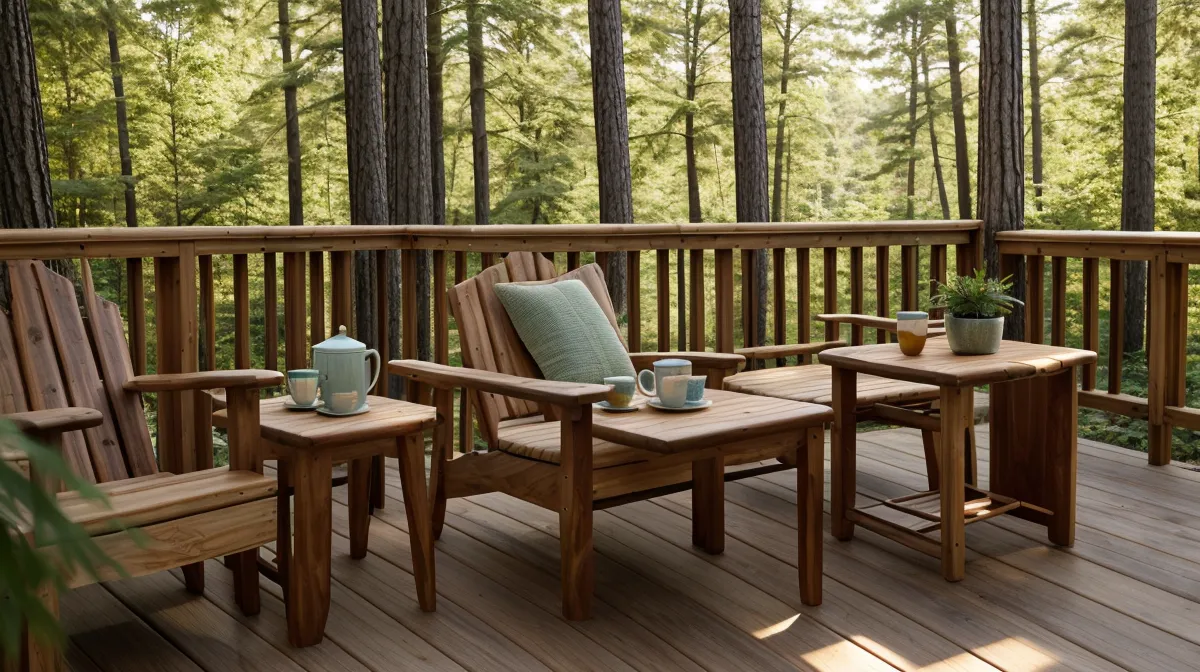
A shed takes three weekends, two permits, and about as many arguments as we can count on both hands. A side table took an afternoon, four legs, and a story I told for a week straight. That gap alone is why we needed a beginner-friendly outdoor furniture project — something small enough to finish between the porch chairs, since the peeling porch railing had officially retired from balancing coffee mugs, and neither of us wanted another big DIY commitment this summer.
Five years into doing basically everything ourselves out here, we've learned the size of a project matters more than the difficulty. The workshop out back proves it, half-sheathed in OSB, a blue tarp still snapping over the open side facing the fence, stalled out somewhere between the electrical panel and a day laborer we brought in last spring to help speed up the framing. We never wrote down who was doing what, so priorities drifted apart within a week, and the framing sat half-finished for a month after he left. Small builds don't have that problem. Nobody to manage but each other.
A Beginner-Friendly Plan We Could Actually Follow
She's the one who actually finds our plans instead of sketching something on a napkin and hoping — a habit that saved us after we swore off winging it years ago. This time she dug through the tablet's folder of saved woodworking plans looking for something that would use up the cedar scraps piled under a tarp beside the workshop, sorted roughly by length, left over from three other projects. A side table needs almost nothing: a square top, four legs, no fancy angles. That was the whole appeal.
Standard lumber sizing trips up almost everyone the first time — a 2x4 never actually measures two inches by four — and we've been burned by that nominal-versus-actual gap before on bigger builds, though this plan already worked in real dimensions, so it barely mattered here.

Cedar Won the Argument Over Pressure-Treated
Rural North Carolina humidity plus wood-hungry insects means outdoor furniture either survives on its own or rots within a couple of seasons. Cedar handles both without help — naturally rot- and bug-resistant — and we had a stack of it left from an earlier build. Pressure-treated lumber would've worked too, but it comes soaked from the treatment process and needs weeks, sometimes months, to dry out before it'll take a finish. We wanted these tables on the porch inside a month, so pressure-treated was out before we even priced it. We'd talked about pulling leftover material from building a lean to shed for lawn mower storage using plans instead — that roof's pitch is steep enough to shed water clean off without ever pooling — but the cedar looked too good to bury under a mower shed roof.
Why Four Legs Came Out Four Different Lengths
He handled the cutting; she handled the sanding. That split has held for five years and neither of us has any interest in swapping. Four legs at the same twenty-two inches, measured off one long board and cut on the line each time, should have been simple. They weren't. Lined up on the workbench, the legs were all slightly different lengths, not by a mile but enough that the table would ROCK on any hard surface. The culprit was the saw blade itself: every cut turns about an eighth of an inch of wood into dust, and if you don't subtract that kerf before marking the next cut, the error stacks the way small overcharges stack on a grocery receipt. Invisible at first, impossible to miss by the fourth item. By the fourth leg, he was nearly half an inch short and had to trim all four down to match the runt of the litter.
No footings to pour for this one, and no permit question either — a side table stays well clear of the size threshold that put the deck in permit territory, and the shed's footings were their own separate headache entirely. A table just needs to sit level and square on four legs, and getting that right after the kerf mess took another twenty minutes with a square and more patience than either of us had left. My hands still remember how the red clay clamped cold and heavy around a post digger after a night of rain; nothing that dramatic here, just a level, a pencil, and a lot of double-checking.
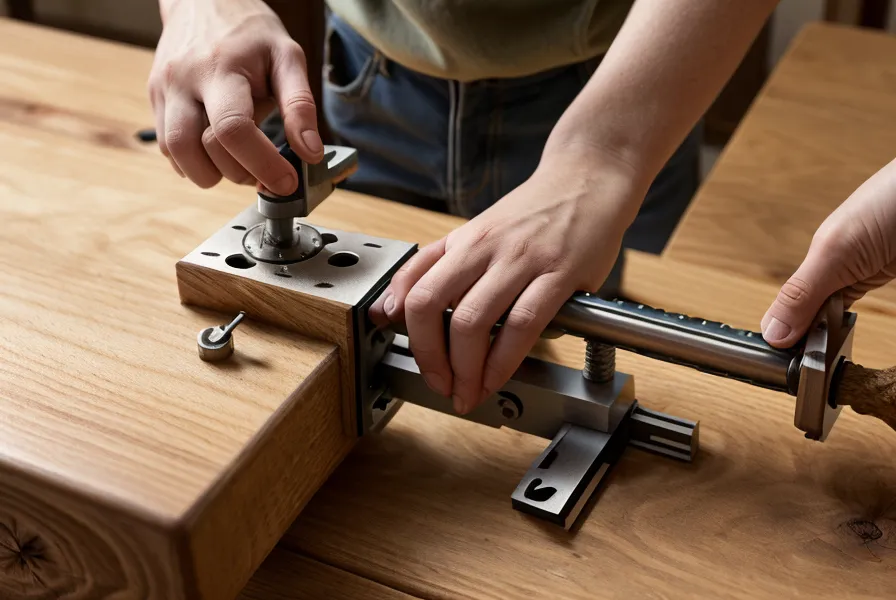
Pocket Holes, Hidden Screws, and a Marriage-Saving Jig
Nobody wants a nice cedar tabletop with silver screw heads staring back every time someone sets a drink down. That argument used to derail assembly day, until pocket-hole joinery ended it for good — drill a hole at an angle into the back of a board, and the screw disappears inside the wood instead of sitting on top of it.
We ran out of the right screws halfway through and made a run to the Home Depot in Apex for a box of 2.5-inch deck screws — 2x material is 1.5 inches thick, and that length gives enough bite into the second board without blowing out the far side. No stud walls to frame and square this time, either, just four legs and a top, over almost before it started. The jig and a drill were about the only two tools this one asked for, a much shorter list than what usually makes our own roundup of the tools we actually reach for.
Skipping the Sealant Everyone Recommends
Every employee at the big-box counter pushes the same thick, plastic-heavy exterior sealant and promises five years out of it. In this humidity, that promise doesn't hold. The sealant traps moisture inside the wood, and within two seasons the finish peels like sunburn, which means sanding the whole piece back to bare wood to fix it. We went with raw linseed oil instead, an old approach that lets the wood breathe and move with the humidity instead of fighting it.
Wood moves seasonally no matter what finish sits on top of it — swelling in the wet months, pulling back in the dry ones — and any joint or gap that doesn't account for that movement eventually cracks or binds, which is half the reason cheap outdoor furniture fails early. Linseed oil needs a fresh coat about once a year, ten minutes and no sanding, and it brings out a deep red in the cedar that raw wood never shows on its own. For anyone weighing finishes on their own build, we broke down why some hold up in the South and others don't in the best wood for outdoor furniture projects in humid North Carolina.

What the Porch Looks Like Now
Two matching tables sit between the porch chairs now, and my coffee mug hasn't tested gravity since. The workshop is still tarped on one side, the deck off the back door is holding square through its second winter, and the chicken coop twenty feet off the fence still needs that new latch.
Wanda Telfair, a reader who wrote in after the coop post, keeps asking in full, polite paragraphs whether the A-frame held up through the ice storms, and every email ends with one more question I haven't fully answered yet — the latch hardware is the one she keeps circling back to. Patrice Wimberly, from the neighborhood Facebook group, saw a photo of the finished tables and asked, half-joking, whether I'd logged the cost the way she tracks every dollar spent on her raised beds. Who actually does that? I hadn't, and I didn't start.
By the seventh week of running one project straight into the next this season, the scrap pile beside the workshop — the one we've pulled cedar and pine from since the shed — had thinned down enough to barely cover half the tarp it used to need. That's the real measure of progress around here: less wood left over, because less of it gets wasted the more we build.
The lesson this one taught us wasn't about kerf or pocket holes or finish. It's that not every project needs to be the big one. Some just need to hold a coffee mug steady, and that's worth doing right too.